

Sleep & Healthcare
Health Care Heroes Need A Break Too
Poor sleep quality, stress, and mental health problems among healthcare workers could impair their cognitive abilities and their clinical decision-making. Thus, increasing the likelihood of making medical errors that may increase the risk to patients.
Health care workers face many stressors, and many studies have shown that sleep plays a major role. For example, a 2016 review of multiple studies on sleep deprivation among nurses found that 55% work over 40 hours a week and 30%-70% report getting fewer than six hours of sleep a night. Research which focuses on nurses and direct-care workers, such as nursing assistants, personal care aides, and home health aides, has had similar findings. They found that 57% of direct-care workers in a long-term care facility and 68% of nurses in a cancer hospital reported experiencing insomnia symptoms like difficulty falling asleep and frequent nighttime awakenings.
Sleep issues are more prevalent in health care workers compared to workers in other industries. A CDC report on 2013-2014 data on 22 major occupation groups found health care support workers and practitioners had the second and third highest levels of short sleep duration – defined as less than seven hours – with 40% of these workers reporting short sleep. A 2018 study found similar results, with health care support occupations continuing to rank second highest at 45%.
Several factors may contribute to healthcare workers’ sleep quality.

Info sourced from The Sleep Foundation.
Physical Strain
Physical Strain can be caused by the perceived physical isolation (restrictions on interaction with others, even after working hours).
Mental Fatigue & Anxiety
The constant vigilance regarding infection control procedures, long working shifts, and conceivable separation and concern about family members with fears of infecting family members and beloved ones
Shift Work Sleep Disorder (SWSD)
This primarily affects people who work night, early morning, and rotating shifts. The disorder may cause insomnia when workers attempt to sleep and/or excessive sleepiness while they are at work. Significant sleep loss usually occurs.
Complications of SWSD

Mood Problems
Shift work disorder can cause people to feel impatient, irritable, and unable to cope with problems or conflicts. Many avoid interacting with their coworkers while on the clock and may also feel less inclined to socially engage with friends and family members when not at work.

Poor Performance
People with shift work disorder often struggle to concentrate, pay attention, and remember things. This can translate to reduced performance at work and added costs for employers.

High Accident Risk
Since shift work disorder decreases alertness and reaction time, it puts workers at higher risk of committing errors or being involved in an accident. In addition to workplace accidents, these individuals are at greater risk of getting into a vehicular accident during their commute due to drowsy driving.
Info sourced from The Sleep Foundation.
Health Professionals Speak on Sleep

Quotes sourced from Pamela Wible MD @ IdealMedicalCare..org
“In general surgery residency I had one week in which I worked 125 hour….I did a weekend of 72 hours in which I only got 4 hours of sleep. I would secretly hope to get in a car accident and maybe break a leg so that I would be forced to take off from work…just so I could get some rest.” — Anonymous
“I have gained easily a hundred pounds over the years in part from eating to stay awake. The state police have woken me up on the side of the road many times when I pulled off the highway to sleep because I couldn’t stay awake until the next exit. — Anonymous
“I have fallen asleep at the wheel thousands of times since medical school. I literally would wake up the next day in my work clothes and not even remember leaving the hospital. I drive from 45 min to 4 hrs to rural hospitals now and in training, currently working up to 7 straight 24’s in a row.” — Anonymous
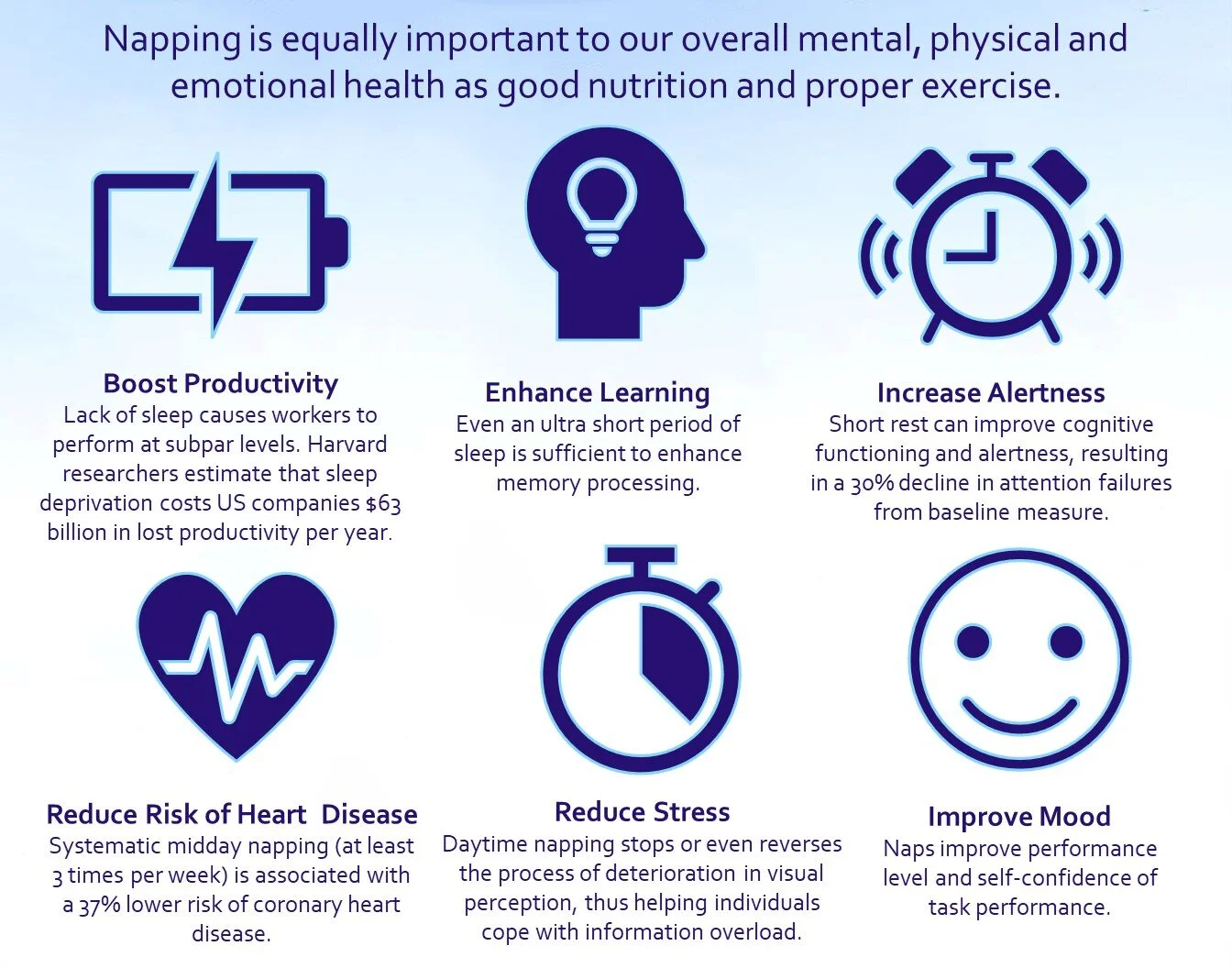
Studies have shown many productivity benefits associated with napping. Naps at work can help employees get the most out of their day, both personally and professionally.

REST is the KEY!
All the content sited can be found on the The Sleep Foundation website. Their site features a highly qualified team made up of physicians, psychologists, academic researchers, and other sleep experts with decades of experience in sleep science and health fields. Their knowledge and insights about sleep science and human health ensure every article and guide on their site reflects the latest data, findings, and trends.
Micro Sleep Survey
We’re changing Sleep, and we could really use your help!
Background: Fatigue resulting from shift work and extended hours can compromise patient care, safety, and health of essential healthcare workers, as well as increasing turnover and health care costs.
Objectives: This sleep survey is aimed to identify aspects of healthcare work patterns associated with increased risk of fatigue-related outcomes.
Survey Design: A national survey of work patterns and fatigue-related outcomes in 6 practice areas expected to have high fatigue risk (child health including neonatology, cardiac care/intensive care, emergency and trauma, in-patient mental health, medical, and surgical nursing).
***Disclaimer*** Your participation in this research study is voluntary. You may choose not to participate. If you decide to participate in this research survey, you may withdraw at any time. If you decide not to participate in this study or if you withdraw from participating at any time, you will not be penalized. The procedure involves filling an online survey that will take approximately 10 minutes. Your responses will be confidential and we do not collect identifying information such as your name, email address or IP address. We will do our best to keep your information confidential. All data is stored in a password protected electronic format. To help protect your confidentiality, the survey will not contain information that will personally identify you. The results of this study will be used for scholarly purposes only and may be shared with Micro Sleep Technologies Inc***
Micro Sleep is currently seeking organizations who share our passion and commitment to pushing the boundaries of what sleep on the go can be through technology. We’ve tapped into something truly extraordinary that can easily be celebrated and utilized because everyone has experienced sleep deprivation at one time or another. We’re eager and ready to prove that users will believe in our company and our mission.
Micro Sleep Technologies Inc.